Chat With Us
+91 98256 37969
Fixed Disc Plough vs Hydraulic Reversible Disc Plough: Which Is Better for Your Farm?
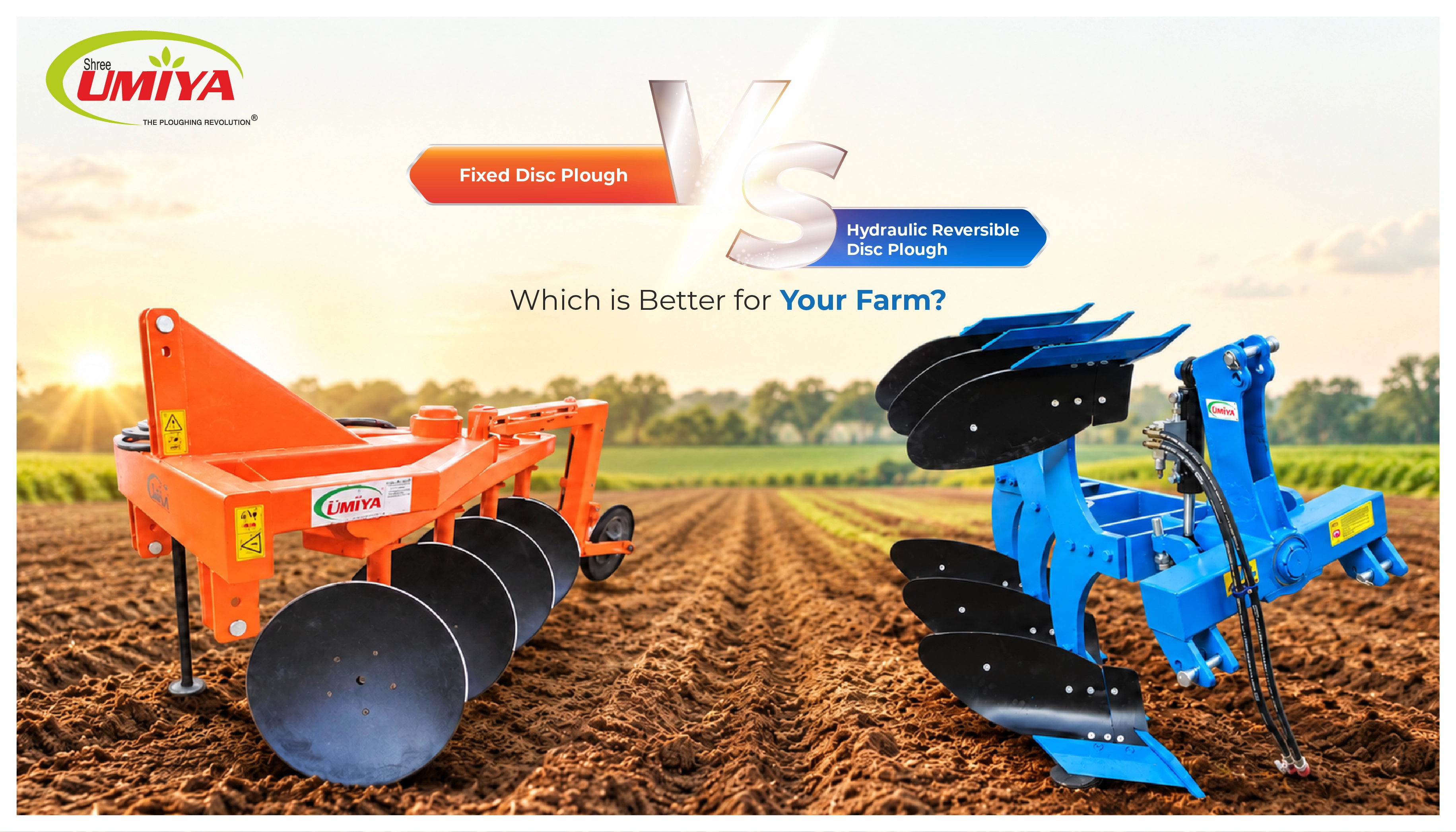
Choosing between a Fixed Disc Plough and a Hydraulic Reversible Disc Plough can affect how efficiently a farm prepares its land. Both are used for primary tillage, but they differ in how they turn soil, manage ploughing direction and operate in the field.
A Fixed Disc Plough is generally better for buyers seeking a simpler, lower-cost implement, while a Hydraulic Reversible Disc Plough may be better for farms that need greater control over soil-turning direction and more organised back-and-forth ploughing.
For farmers, agricultural machinery distributors and importers, the right choice depends on soil conditions, tractor compatibility, field layout, maintenance requirements and overall operating costs.
What Is a Fixed Disc Plough?
A Fixed Disc Plough is a tractor-mounted agricultural implement that uses angled, concave discs to cut, lift and turn soil during primary tillage.
Its disc arrangement remains in a fixed working orientation. Unlike a reversible model, it does not use a reversing mechanism to change the direction in which soil is turned.
As the tractor moves forward, the discs rotate through contact with the ground, cutting into the soil and moving it to one side.
When Is a Fixed Disc Plough Suitable?
A Fixed Disc Plough can be a practical choice when:
- The farm requires straightforward primary tillage.
- Operators are familiar with conventional ploughing patterns.
- The buyer prefers fewer hydraulic components.
- Initial equipment cost is an important consideration.
- Field layout allows convenient management of soil-turning direction.
However, performance still depends on disc size, working depth, tractor power and soil conditions. A fixed design does not automatically mean that it requires less tractor power.
What Is a Hydraulic Reversible Disc Plough?
A Hydraulic Reversible Disc Plough is a primary tillage implement equipped with concave discs and a hydraulic mechanism that changes the direction of soil inversion.
At the end of a working pass, the operator uses the tractor's hydraulic system to reverse the plough's working orientation. This allows the implement to turn soil in the required direction during the next pass.
The tractor must still turn at the headland, but the reversible mechanism helps operators maintain a more consistent ploughing pattern without relying on the same fixed soil-throw direction.
Shree Umiya manufactures Hydraulic Reversible Disc Ploughs for demanding tillage applications. Its product range includes multiple configurations designed for different working requirements and tractor capacities.
When Is a Hydraulic Reversible Disc Plough Suitable?
This configuration is worth considering when:
- Farmers regularly plough medium or large fields.
- Controlling soil-turning direction is important.
- Operators want to manage ridges and dead furrows.
- The farm uses repeated back-and-forth ploughing passes.
- Tractor hydraulic compatibility has been confirmed.
The reversible mechanism provides operational flexibility, although actual time and fuel savings depend on the field and equipment combination.
Fixed Disc Plough vs Hydraulic Reversible Disc Plough: Key Differences
Both implements use concave discs for soil cutting and turning. Their main difference is the ability to change soil-throw direction.
| Feature | Fixed Disc Plough | Hydraulic Reversible Disc Plough |
| Soil-turning direction | Fixed working direction | Direction can be changed |
| Reversing mechanism | Not required | Hydraulic mechanism |
| Initial investment | Generally lower | Generally higher |
| Ploughing pattern | Conventional directional pattern | More flexible back-and-forth pattern |
| Tractor requirements | Suitable linkage and power | Suitable linkage, power and hydraulics |
| Maintenance | Generally simpler | Additional hydraulic components |
| Field suitability | Simple ploughing requirements | Fields needing directional flexibility |
| Operating efficiency | Depends on field and setup | May improve with suitable field layout |
Neither configuration is automatically better in every situation. Buyers should compare specific models rather than assuming all fixed or reversible ploughs perform identically.
Which Disc Plough Is Better for Different Soil Conditions?
Soil conditions influence how a disc plough penetrates, cuts and turns the ground.
Hard and Dry Soil
Disc ploughs may be useful in firm or dry soil where suitable disc geometry helps the implement enter and work the ground.
However, soil penetration depends on implement weight, disc angle, soil moisture and tractor traction.
Both fixed and reversible models can be considered. The reversing mechanism itself does not guarantee deeper penetration.
Sticky or Clay-Rich Soil
Wet, sticky soil can adhere to working components and increase draft resistance.
Disc configuration, scraper arrangements where fitted, and appropriate operating conditions matter more than whether the implement is fixed or reversible.
Avoiding tillage when soil is excessively wet can also help prevent compaction and structural damage.
Residue-Rich Fields
Disc ploughs can cut through and incorporate manageable crop residues during primary tillage.
The effectiveness of residue handling depends on disc spacing, residue quantity, working depth and field conditions.
For buyers working with substantial crop residues, it is important to evaluate the specific model's clearance and working performance.
How Does Plough Design Affect Field Efficiency and Operating Costs?
A Hydraulic Reversible Disc Plough may help reduce the need for certain ploughing patterns used to manage soil thrown consistently to one side.
This can be useful where operators want to avoid repeated formation of ridges and dead furrows.
However, the reversible mechanism does not eliminate headland turning or guarantee fewer passes.
Consider two examples:
Scenario 1: A smaller farm with straightforward field preparation
A farmer operates a suitable tractor on a relatively simple field and requires occasional primary tillage. A Fixed Disc Plough may provide the required performance without the additional investment in a hydraulic reversing system.
Scenario 2: A commercial farm with repeated ploughing operations
A farmer regularly prepares larger fields and wants greater control over soil inversion direction. A Hydraulic Reversible Disc Plough may offer operational advantages that justify its higher purchase and maintenance costs.
To compare operating costs properly, buyers should consider fuel consumption per hectare, working width, field efficiency, labour requirements, maintenance and equipment purchase price.
What Tractor Specifications Should Buyers Check?
Tractor compatibility should be confirmed before purchasing either type of disc plough.
Important specifications include:
- Horsepower: Match the tractor's available power to the implement's draft requirements.
- Hydraulic system: Confirm hydraulic outlets, pressure and flow requirements for reversible models.
- Linkage: Verify three-point linkage compatibility and lifting capacity.
- Implement weight: Check whether the tractor can safely lift and balance the equipment.
- Working width and depth: Select a configuration suited to the tractor and field conditions.
A tractor with sufficient horsepower may still be unsuitable if its hydraulic system, linkage or lifting capacity does not meet the implement's requirements.
For importers and distributors, requesting model-specific compatibility information can help prevent problems after delivery.
What Should Importers and Distributors Consider Before Ordering?
Agricultural equipment distributors should evaluate more than the initial selling price.
Before selecting a Fixed Disc Plough or Hydraulic Reversible Disc Plough for their product range, they should ask manufacturers about product configurations, spare parts, warranty terms and technical support.
Important components to discuss include discs, bearings, hydraulic cylinders, seals and other replaceable parts relevant to the selected model. Importers should also confirm packaging dimensions, order quantities, production lead times and export documentation requirements.
For example, a distributor serving customers with limited hydraulic tractor capabilities may need to prioritise simpler configurations. Another distributor serving commercial farms with compatible tractors may find stronger demand for hydraulic reversible models.
The appropriate product mix should be based on actual customer requirements rather than assuming that a more advanced configuration will suit every buyer.
Explore Fixed and Hydraulic Reversible Disc Ploughs from Shree Umiya
Shree Umiya is the agricultural implement brand, an Indian manufacturer established in 1997. The company offers agricultural machinery for primary tillage, soil preparation and other farming operations.
For importers and distributors, selecting the appropriate model begins with understanding the intended tractor fleet, soil conditions, field applications and local demand.
Explore Shree Umiya's Reversible Disc Plough range or contact the company to discuss available configurations, technical specifications and export enquiries.
FAQs
Ques
What is the main difference between a Fixed Disc Plough and a Hydraulic Reversible Disc Plough?
Ans
A Fixed Disc Plough turns soil in a fixed direction, while a Hydraulic Reversible Disc Plough allows the operator to change the soil-turning direction using a hydraulic mechanism. Both use concave discs for primary tillage.
Ques
Is a Hydraulic Reversible Disc Plough better for large farms?
Ans
It can be beneficial for larger fields where flexible soil-turning direction helps maintain an organised ploughing pattern. However, suitability depends on tractor compatibility, field layout and the amount of ploughing required.
Ques
Can a Fixed Disc Plough work in hard soil?
Ans
Yes, a properly configured Fixed Disc Plough can work in certain hard soil conditions. Performance depends on disc design, implement weight, soil moisture, working depth and tractor traction.
Ques
Does a Hydraulic Reversible Disc Plough require more maintenance?
Ans
It generally has additional hydraulic components that require inspection and maintenance. Actual servicing requirements depend on the model, operating conditions and manufacturer's recommendations.
Ques
Which disc plough should agricultural equipment importers choose?
Ans
Importers should select models based on customer tractor specifications, soil conditions, field sizes, spare parts requirements and purchase budgets. Offering both configurations may be appropriate when there is verified demand for each.
-
Previous Blog

Shree Umiya
Farm Implements Manufacturer
As a proud member of the Shree Umiya team, I'm here to share our expertise & insights of high-quality farm implements like reversible ploughs & tractor operated sprayers. Join us to explore the commitment to quality that define our brand.
Latest Posts
-
October 06, 2026
-
September 22, 2026
-
September 21, 2026
