Chat With Us
+91 98256 37969
How to Choose a Reversible Disc Plough for Tanzanian Farms
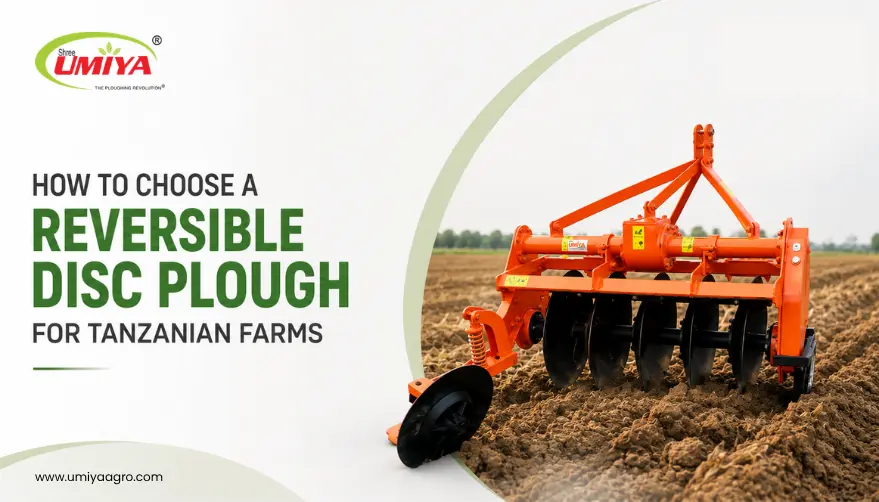
Effective primary tillage can make later farming operations easier by helping farmers prepare the soil, incorporate manageable crop residues and disturb existing weeds before planting. For Tanzanian farmers working across different soil types, field sizes and crop systems, choosing the right tillage implement is therefore an important part of farm planning.
A Reversible Disc Plough can support primary tillage by cutting and turning soil while allowing the direction of soil inversion to be managed across successive passes. When correctly matched to the tractor, soil condition and field requirements, it can help farmers prepare fields more efficiently without relying on unnecessary tillage operations.
How Does a Reversible Disc Plough Work?
A Reversible Disc Plough uses angled discs to cut and turn soil during primary tillage. Its reversible configuration allows the direction of soil throw to be changed, helping farmers maintain a more organised ploughing pattern. The implement can also disturb weeds and incorporate manageable crop residues into the worked soil layer.
Actual performance depends on disc configuration, working depth, soil condition, tractor power and operating speed.
What Are the Advantages of a Reversible Disc Plough?
A Reversible Disc Plough can help Tanzanian farmers with primary tillage by turning soil, incorporating manageable crop residues, disturbing existing weeds and preparing fields for subsequent operations. Its reversible configuration can also help maintain a more practical ploughing pattern across the field. However, performance depends on soil condition, tractor compatibility, working depth and proper operation.
1. Incorporate Manageable Crop Residues
The field will have stalks, roots, weeds, and other vegetation after harvesting. In case these residues are not handled carefully, they may become obstacles in future farming operations in the field.
Ploughing is useful in planting these residues underneath the soil, where they can decompose. Adding organic matter to the soil can be part of soil management as well as clearing the surface for future farming activities.
Nevertheless, the amount of residue and the soil must be taken into consideration at all times. Very thick residues may need specific residue handling machinery.
2. Choose the Plough According to Soil Conditions
The soils from the Tanzanian agricultural land may vary in texture and condition. The conditions may either be favorable or difficult for tillage depending on the nature of the soils. There are some areas where the working conditions may be easier compared to other areas.
A robust disc type tool will be useful in cases of varying field conditions provided that it is appropriately matched to the tractor and used in the right moisture conditions. It is wise for the farmers to consider the soil condition before opting for any method of tillage. Moisture content is especially very significant since working on soils that are too wet or dry will pose challenges.
3. Support Weed Management Through Primary Tillage
Weeds are capable of competing with crops for water, nutrients, sunlight, and space for growth. The process of tillage can be considered to be used within an integrated weed management system that buries existing weeds in the soil.
This can be effective based on weed type, timing, soil condition, and future management of the crops. It should be noted that tillage is only a part of a weed control strategy and cannot replace all other methods.
4. Match the Plough to Your Tractor
An implement designed to be effective will not function efficiently if it does not match the tractor well. Tractor horsepower, hydraulic capacity, field size, depth of work, and the weight of the equipment should all be considered before buying any equipment.
If the plough consumes more power than what the tractor can comfortably supply, then more fuel will be consumed by the tractor and also put undue strain on the machine. On the other hand, if the equipment purchased is smaller compared to the needs of the farm, more runs will be required in the preparation process.
For farmers comparing agricultural implements for Tanzanian operations, Shree Umiya Agro can provide equipment options based on the tractor, field conditions and intended tillage application.
5. Check Disc and Component Condition Regularly
Farm equipment should always be attended to for it to remain reliable during the entire season. Disc condition, bearing, fasteners, frame parts, and other moving parts must be regularly inspected.
The wear of discs may influence the cutting and turning capabilities of the equipment. Proper replacement of worn-out parts could assist in ensuring steady performance in the field and prevent potential problems.
Farmers must adhere to the manufacturer's instructions regarding lubrication, adjustment, storage, and regular inspection of their farm equipment.
Integrate the Reversible Disc Plough Into Your Tillage Strategy
The benefits of a reversible plow will become significant only if it works in conjunction with an effective agricultural system. The farmers must pay attention to pre-primary tillage and post-primary tillage practices in order to manage residues, prepare secondary seedbeds, plant, and conserve moisture in the soil.
Every field does not require the same amount of tillage. Sometimes excessive soil disturbance can run contrary to the objectives of the soil management system. Therefore, the farmers must conduct themselves according to the needs of the fields.
Effective tillage equipment is the one which allows the farmer to create desired soil condition in a reasonable manner using appropriate inputs.
Choose the Plough Around Your Field Requirements
A Reversible Disc Plough can support efficient primary tillage by cutting and turning soil, incorporating manageable crop residues and disturbing existing weeds. However, the right result depends on choosing equipment that matches the farm's soil conditions, tractor capacity, working depth and field requirements.
For Tanzanian farmers, the goal should not be to choose the largest or most powerful implement available. It should be to select a Reversible Disc Plough that fits the actual farming system and can deliver consistent field preparation without unnecessary passes or equipment strain.
Shree Umiya Agro provides agricultural implements for farmers looking to improve mechanized field operations and soil preparation. Contact the team to discuss suitable equipment for your farm requirements.
FAQs
Ques
What tractor is required for a Reversible Disc Plough?
Ans
The required tractor depends on the specific plough's size, weight, working width and operating depth. Farmers should follow the manufacturer's recommended tractor horsepower and hydraulic requirements.
Ques
What is a Reversible Disc Plough?
Ans
A Reversible Disc Plough is a primary tillage implement that uses discs to cut and turn soil. Its reversible configuration allows the direction of soil throw to be changed during field operations.
Ques
What are the advantages of a Reversible Disc Plough?
Ans
The main advantages include soil cutting and turning, manageable crop-residue incorporation, weed disturbance and efficient primary tillage when the implement is correctly matched to the tractor and field conditions.
Ques
Is a Reversible Disc Plough suitable for Tanzanian farms?
Ans
It can be suitable for farms in Tanzania where primary tillage requires soil cutting and turning, provided the implement is matched to the soil condition, tractor capacity, field size and intended working depth.
Ques
Can a Reversible Disc Plough handle crop residue?
Ans
It can incorporate manageable amounts of crop residue into the worked soil layer. Heavy residue conditions may require additional residue-management equipment or a different tillage sequence.
Ques
How should a Reversible Disc Plough be maintained?
Ans
Farmers should regularly inspect discs, bearings, fasteners, frame components and other wear parts. Lubrication, adjustment and replacement of worn components should follow the manufacturer's recommendations.
-
Previous Blog

Patel Agro
Farm Implements Manufacturer
As a proud member of the Shree Umiya By Patel Agro Industries team, I'm here to share our expertise & insights of high-quality farm implements like reversible ploughs & tractor operated sprayers. Join us to explore the commitment to quality that define our brand.
Latest Posts
-
August 19, 2026
-
August 17, 2026
-

August 13, 2026
