Chat With Us
+91 98256 37969
How Rotary Disc Harrow Can Increase Productivity in Nepal
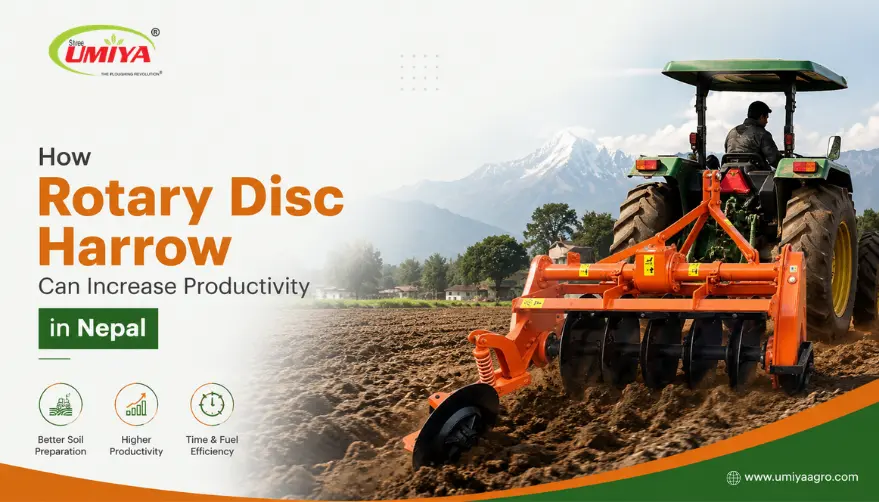
However, agricultural efficiency is not entirely dependent upon the size of the farm cultivated. The manner by which the land will be prepared can play a similarly significant role in the agricultural process. Farmers in Nepal may operate under differing levels of terrain, soil quality and farm size, thus the efficiency and effectiveness of field preparation is especially significant. In instances where soil preparation becomes lengthy and repetitive, time, energy, and resources can all be wasted before planting even begins.
Rotary Disc Harrow can make the soil preparation process a simple affair, as it cuts, breaks, mixes and levies the soil in one go. If properly suited to the farm environment, it can aid farmers to accomplish their task of preparing the land faster.
Across Nepal, farmers grow crops such as rice, maize, wheat, mustard, and vegetables in diverse farming regions ranging from the Terai plains to the mid-hill landscapes. Efficient soil preparation is especially important where short planting windows, varying soil conditions, and changing weather patterns require field operations to be completed on time.
How does a rotary disc harrow increase productivity?
A rotary disc harrow helps farmers in Nepal increase productivity by preparing the soil in a single operation, reducing repeated tractor passes, incorporating crop residue, and creating a more uniform seedbed before planting. This improves field efficiency while saving time, fuel, and labor during critical planting seasons.
Why Rotary Disc Harrows Improve Soil Preparation
Land preparation following harvest may be done by crushing soil clods, incorporation of residues, and providing an ideal seedbed for cultivation. When the processes described above are carried out individually, there will be an increased number of tractor operations and thus an extended time for land preparation.
Rotary disc harrows combine some of the functions described above. The discs of the rotary disc harrows cut through the top soil layer and crush and mix the soil. This equipment makes it easier for the farmers to create a uniform seedbed without having to use various operations.
It creates more than just a prepared land; it helps start the process of planting.
Reduce Tractor Passes and Save Fuel
Each extra crossing of the farmland requires the use of fuel, tractor hours, and labor. In farms where planting periods are few, such crossings can cause delays in planting and impact the whole farming schedule.
By employing an attachment capable of doing several operations related to soil preparation in one pass, farmers will minimize needless crossings of the farm land. This will also help them have more time to concentrate on planting, irrigation, fertilizing, and other important work.
This proves to be extremely helpful when farmers have to get ready for planting in quick succession.
Manage Crop Residue More Efficiently
Residues left on the land after harvest can pose a problem in preparing the land for the next crop. Residues like stalks and plant material can cause problems during cultivation unless properly handled.
A disc-type harrow will help mix residues from the previous crop into the soil. Once mixed in, the organic material can decompose naturally and increase the organic matter of the soil.
Rather than just seeing the residue from the last harvest as an item to clear from the field, they can integrate it into their soil management plan.
Create a Uniform Seedbed for Better Planting
A uniform seedbed allows for an improved base on which crops can be established. The presence of cloddy soil and uneven surfaces may pose some difficulties during planting processes.
The disc harrow plays a very important role in breaking down big soil aggregates and providing uniform distribution of soil within the working area. Improved surface and workability allow for the facilitation of further planting processes.
However, the preferred soil condition varies depending on the specific crop and field. Tillage is known to disrupt soil structure, thus, the choice of operation depends on field needs.
Traditional Field Preparation vs Rotary Disc Harrow
| Task | Traditional Method | Rotary Disc Harrow |
| Soil breaking | Multiple passes | Single operation |
| Crop residue mixing | Separate process | Integrated |
| Seedbed preparation | Moderate | More uniform |
| Tractor hours | Higher | Lower |
| Fuel consumption | Higher | Reduced passes |
| Planting readiness | Slower | Faster |
Make Better Use of Nepal's Farming Windows
In many cases, agricultural processes have to be conducted within certain periods of the year. Any delay in preparation of the field will affect the process of planting crops.
Using mechanized soil preparation will make it easier for farmers to conduct their field work, especially with the preparation of bigger areas. Instead of wasting lots of time on either manual preparation or repeated passes by tractor, farmers can use certain tools to prepare their fields.
This will allow farmers to save time, which may come in handy when the weather conditions are unpredictable or when multiple agricultural activities have to be conducted within a short time.
Turn Faster Preparation into Greater Farm Efficiency
Productivity is not simply about producing more crops. It also involves making better use of available resources. Saving tractor hours, reducing unnecessary field passes, managing residue effectively, and completing preparation on time can all contribute to a more efficient farming system.
A well-planned mechanization strategy can also reduce the physical workload associated with repeated field operations. This allows farmers to dedicate more time to crop monitoring and other decisions that directly influence the growing season.
Prepare Faster, Farm Smarter
The efficient preparation of soil makes a significant contribution to the process of farming in Nepal. The Rotary Disc Harrow helps in breaking up the soil, mixing it up, incorporating residues into the soil, and making a seedbed all at once while minimizing the number of trips made on the field. By selecting an appropriate tool based on soil type, tractor capacity, land size, and other requirements, farmers may make the best use of their time, fuel, labor, and equipment.
Looking for reliable equipment to make the preparation of fields easier? At Shree Umiya Agro, we manufacture agricultural tools that are meant to help farmers perform field operations efficiently.
FAQs
Ques
What is a rotary disc harrow used for?
Ans
A rotary disc harrow is used to break soil clods, mix crop residue, level the field surface, and prepare a seedbed before planting.
Ques
Is a rotary disc harrow suitable for Nepal?
Ans
Yes. It is suitable for many farming regions in Nepal where timely soil preparation is important for crops such as rice, wheat, maize, mustard, and vegetables.
Ques
How does it reduce fuel consumption?
Ans
By combining multiple soil preparation tasks into fewer tractor passes, it can reduce unnecessary fuel use and tractor operating hours.
Ques
Can it be used after harvesting?
Ans
Yes. It is commonly used after harvest to incorporate crop residue into the soil and prepare land for the next crop cycle.

Shree Umiya
Farm Implements Manufacturer
As a proud member of the Shree Umiya team, I'm here to share our expertise & insights of high-quality farm implements like reversible ploughs & tractor operated sprayers. Join us to explore the commitment to quality that define our brand.
Latest Posts
-
September 22, 2026
-

September 21, 2026
-

September 17, 2026
