Chat With Us
+91 98256 37969
What Importers Should Evaluate Before Choosing a Farm Implement Manufacturer
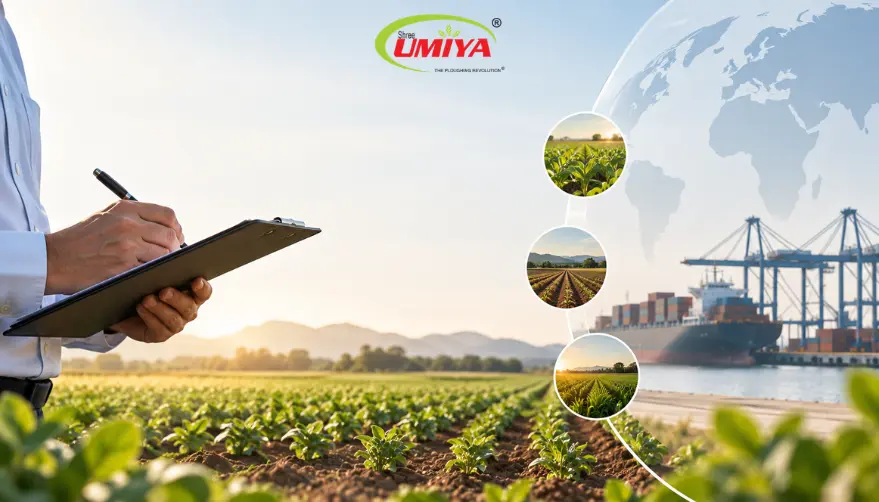
The selection of an appropriate supplier of agricultural machines is a business decision that will have long term effects. Although the agricultural machine may seem like a good bargain from the specifications paper, the true worth of the machine depends on build quality, compatibility, production consistency, support after purchase, and the ability of the supplier to comply with exportation requirements.
Importers need to consider more than just the price of the agricultural machines when selecting the right supplier.
What Is a Farm Implement Manufacturer?
A farm implement manufacturer designs and produces agricultural equipment used for operations such as soil preparation, tillage, planting, crop care and other field activities. For international importers, a manufacturer offers more than a product catalogue: its manufacturing capability, quality control, technical specifications and ability to support repeat orders can directly affect the importer's distribution business.
An exporter of farm implements, meanwhile, needs to manage the additional requirements involved in supplying agricultural equipment to international markets, including packaging, documentation, logistics and communication with overseas buyers.
What Should Importers Check When Choosing a Farm Implement Manufacturer?
| Evaluation area | What importers should check |
| Manufacturing capability | In-house production, machinery and production processes |
| Product quality | Materials, construction, welds, finish and consistency |
| Technical specifications | Dimensions, working width, weight, depth and tractor requirements |
| Customization | Ability to adapt products to market requirements |
| Production capacity | Ability to fulfil trial and larger repeat orders |
| Quality control | Inspection processes and batch consistency |
| Export experience | Previous international shipments and documentation |
| Packaging | Protection during handling and transportation |
| Spare parts | Availability of wear parts and replacement components |
| After-sales support | Manuals, technical guidance and communication |
| Communication | Responsiveness and clarity throughout the order |
| Repeat-order consistency | Ability to reproduce approved products |
The Real Test Starts Beyond the Product Catalogue
A big catalog is good to look at, but that does not automatically mean that the company manufactures. It would be wise for importers to know the products of the supplier, the market served by the company, and whether the machines are built for varied agricultural needs.
Importers can ask direct questions about where the equipment is manufactured, which components are produced in-house, what quality checks are performed and whether the same models can be reproduced for future orders. Factory photographs, production information, technical drawings, samples and product documentation can also help buyers understand the supplier's manufacturing capability.
A reputable manufacturer of farm implements would always be in a position to offer detailed specifications about the products including information on how it operates and tractor compatibilities. This enables the importer to know if the equipment will perform well in his market rather than just looking at pictures.
How Can Importers Verify a Farm Implement Manufacturer?
Before placing a large order, importers can request:
- Factory and production information
- Product catalogues and technical datasheets
- Product photographs and videos
- Physical samples where practical
- Recommended tractor specifications
- Quality-control procedures
- Production capacity information
- Packaging details
- Export references or shipment experience
- Spare-parts information
- Warranty terms
- Installation or operating manuals
Build Quality Is Where Long-Term Value Shows Up
Since farm machines have to work in harsh field environments, the quality of construction will determine the lifespan and performance of the equipment. The importer should assess the materials, frame durability, mechanisms, welds, finishing, and other relevant factors of construction.
It is also helpful to inquire about quality control processes in the manufacture of the equipment. Regular inspection at various stages of production will help avoid problems associated with varying performance of equipment delivered in different shipments.
When assessing the potential farm implement manufacturer for the importer, all these aspects may be more significant than just the comparison of costs. Cheaper equipment will become costly in the long term if it needs constant repair and replacement.
Can the Manufacturer Handle Your Market’s Requirements?
Agricultural machinery differs greatly from country to country and from region to region. The characteristics of the soil, the crops cultivated, the size of the farm, the specification of the tractor used, and other factors may determine the equipment required.
It is important for the importer to verify if the equipment supplier can customize or modify their products based on their customers’ need, in terms of working width, attachments, tractors’ power, or other considerations.
The knowledge of these differences makes it more likely that the equipment supplier will provide machinery adapted to the needs of the customer.
Production Capacity Matters When Orders Start Growing
A manufacturer might easily cope with the delivery of a test order, yet face problems delivering orders when demand grows. Hence, it is advisable for importers who intend to create a line of products to check whether the manufacturer is ready to produce in large volume.
Inquiries regarding manufacturing capacity, timeframes required to manufacture goods, usual order quantities, packaging issues, and the capacity to deliver consistent production despite high loads can influence inventory management and delivery schedules directly.
The question becomes critical for an exporter of farm implements, since foreign buyers rely on the consistency of supply schedules. A competent manufacturer will be able to set realistic timetables.
Export Experience Can Prevent Costly Surprises
International shipments entail not just the production of machinery. The issues like documentation, packaging, loading, transportation, and other things related to shipment may have implications on the success of an order.
Therefore, importers need to consider whether the supplier has experience of dealing with international orders and knows the documentation that should be used during exports. Packaging also matters since the agricultural machinery needs to go through many hands before it gets to the end consumer.
For importers evaluating an Indian supplier, Shree Umiya Agro can be considered based on factors such as its farm implement range, manufacturing capabilities, product specifications, export requirements and ability to support international buyers. Importers should evaluate the specific models they require and confirm technical specifications, production timelines, packaging and support before placing an order.
After-Sales Support Should Be Part of the Deal
The relationship between importer and manufacturer of farm implements should not come to an end just because the goods leave the factory premises. Users of farm machinery might require some sort of instructions on how to operate the equipment, spare parts, technical information, or identification of substitute parts.
Importers should find out what after-sales support is possible after delivery and whether there are any spare parts regularly required by the customers. Product manuals and technical literature might also simplify distributors' task.
A supplier who regards after-sales service as part of his business dealings can provide some help to importers in building confidence in their products.
The Right Manufacturer Should Make Expansion Easier
The selection of the supplier, therefore, is more of a business decision than a one-time transaction. The importers need to consider the following qualities of the supplier: manufacture capabilities, quality of the products, manufacturing reliability, experience in exporting, technical knowledge, and good communication.
FAQs
Ques
What should I check before choosing a manufacturer of farm implements?
Ans
Check manufacturing capability, product quality, technical specifications, tractor compatibility, production capacity, customization, export experience, packaging, spare parts and after-sales support.
Ques
How do I verify whether a farm implement company is a manufacturer?
Ans
Ask about manufacturing facilities, production processes, quality control, product specifications, factory capabilities and whether equipment is produced in-house or sourced from third parties.
Ques
Why is tractor compatibility important when importing farm implements?
Ans
An implement needs to match the tractor's power, linkage, hydraulic or PTO requirements, weight capacity and intended field operation.
Ques
What should I look for in an exporter of farm implements?
Ans
Evaluate export experience, packaging, documentation, production reliability, communication, logistics coordination and ability to support repeat international orders.
Ques
Can an Indian farm implement manufacturer customize equipment?
Ans
Some manufacturers offer customization or configuration changes, but availability depends on the product, manufacturing process, minimum order quantity and technical requirements.
Ques
How important is after-sales support for imported farm machinery?
Ans
It can be important because distributors and end users may require manuals, spare parts, technical information and troubleshooting support after delivery.

Shree Umiya
Farm Implements Manufacturer
As a proud member of the Shree Umiya team, I'm here to share our expertise & insights of high-quality farm implements like reversible ploughs & tractor operated sprayers. Join us to explore the commitment to quality that define our brand.
Latest Posts
-
September 22, 2026
-
September 21, 2026
-
September 15, 2026
