Chat With Us
+91 98256 37969
Tractor Mounted Boom Sprayer Buying Guide in Uganda
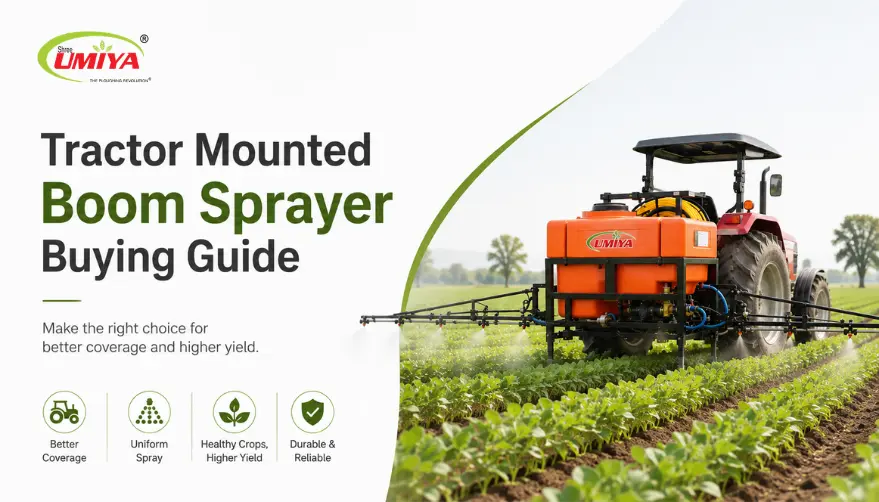
The right sprayer depends on more than price. Farm size, tractor horsepower, tank capacity, boom width, nozzle configuration, crop type, field conditions and maintenance requirements all influence whether a Tractor Mounted Boom Sprayer will perform effectively. For farmers in Uganda, evaluating these factors before purchase can help avoid choosing equipment that is either undersized for the farm or unnecessarily difficult to operate.
Ugandan farms can range from smaller agricultural holdings to large commercial operations, with differences in terrain, crop type, field layout and access conditions. The right boom sprayer therefore needs to be matched to the specific farm rather than selected only by tank size or price.
A Tractor Mounted Boom Sprayer can assist in the systematic coverage of a larger area, along with ensuring uniformity in the spraying process. The selection of such a sprayer calls for careful considerations of various aspects.
What Is a Tractor Mounted Boom Sprayer?
A Tractor Mounted Boom Sprayer is a tractor-operated agricultural spraying machine that uses a tank, pump, boom and spray nozzles to distribute liquid crop-protection products or other agricultural solutions across a field. The boom allows multiple nozzles to cover a wider area in a single pass.
1. Assess Your Farm Before Choosing a Sprayer
The initial requirement is the realization of the purpose of the equipment itself. A small farm having small sections in its fields may require different equipment than a large commercial farm having large areas of open fields.
In such cases, the farmer must think about the crops being raised, area covered by those crops, number of times spraying will be done, field design and type of application needed. This could help decide the right size of the tank, boom design and capacity of the machine.
This helps in buying the equipment according to one’s own need and not buying an unnecessary machine for his own farm.
2. Match the Sprayer to Your Tractor
It is important for both pieces of equipment to be compatible with each other. Before buying, it would be wise for the farmer to evaluate the horse power, hydraulic system, three point linkage capacity, and attachments that may be made to the tractor.
If the sprayer to be used is too bulky or too much for the tractor, then the efficiency would be compromised. Conversely, using equipment that would suit the tractor would make things easier.
Always consult with the manufacturers' guidelines before coming up with any decision.
3. Choose Tank Capacity According to Field Size
Tank volume determines the frequency at which the machine will require refilling. Higher tank volumes can assist in reducing the disturbances caused when treating large fields, whereas smaller volumes would be convenient in cases of smaller fields and lack of abundant water sources.
It is not the only factor that should be considered. The higher the volume, the heavier the machine becomes once it is filled, and it impacts tractor selection and maneuverability in the field.
Optimal tank volume depends on various factors like application requirements, tractor capacity, water sources, and size of areas being treated.
4. Pay Attention to Nozzles and Spray Uniformity
The width of the boom will dictate how much land gets worked in one pass. An advantage of having a wide boom is that there will be an increased amount of field coverage and fewer passes made over large, open fields.
However, having equipment that is too wide may not always be a wise choice. Fields that have barriers, narrow rows, or are difficult to navigate may require something else.
It is for this reason that the layout of fields needs to be taken into account by farmers along with their work pace.
5. Pay Attention to Nozzles and Spray Uniformity
The function of the nozzles is essential in the efficiency of the spray since they affect the distribution of the liquid on the boom. The kind of nozzle used, the spacing between them, the pressure that they operate under, and their condition will affect the uniformity of the spraying process.
A farmer should ensure that the configuration of the nozzle is suitable for the type of crop being sprayed. This is because worn out or clogged nozzles might lead to uneven distribution leading to some sections receiving excess chemicals and others too little.
It is, therefore, important to inspect and clean the nozzles from time to time.
6. Consider Field Conditions in Uganda
Every area does not provide the same operational ground. Unstable ground, muddy parts, limited access paths, and diverse cropping patterns can influence the ease with which machines operate in farms.
Farmers need to take into consideration the nature of the ground before selecting any machines for use. What could work effectively on a large flat ground may demand extra considerations in a sloped or hard-to-access ground.
It is important to have regard for the tractor's stability and the spraying machine's load when working in rough grounds.
7. Check Pump Capacity and Operating Pressure
The pump is one of the key components of a Tractor Mounted Boom Sprayer because it influences how effectively the spraying system can deliver liquid through the nozzles. Before purchasing, farmers should evaluate:
- Pump capacity
- Operating pressure
- Flow rate
- Compatibility with nozzle requirements
- Ease of maintenance
- Availability of replacement parts
The pump should be suitable for the sprayer's boom configuration and intended application. Farmers should also consider whether replacement parts and servicing are readily available, as this can affect long-term equipment reliability.
Avoid choosing a sprayer based on pump specifications alone. The pump, tank, boom, nozzles, tractor and application requirements should work together as a complete spraying system.
What Should You Check Before Buying a Tractor Mounted Boom Sprayer?
- Farm size and crop type
- Tractor horsepower
- Three-point linkage capacity
- Tank capacity
- Boom width
- Pump capacity
- Nozzle type and spacing
- Field terrain
- Maintenance requirements
- Spare-parts availability
- Manufacturer support
- Total operating cost
Choose a Sprayer That Works With Your Farm
Choosing a Tractor Mounted Boom Sprayer for a Ugandan farm requires more than comparing prices. Farm size, tractor compatibility, tank capacity, boom width, pump and nozzle configuration, field conditions and maintenance support should all be evaluated together. The right combination can help farmers improve spraying efficiency while avoiding equipment that is difficult to operate or unnecessarily large for their requirements.
If you want reliable agricultural machines that are suitable for proper field operations, then Shree Umiya Agro has what you need to achieve organized and effective spraying of crops in Uganda.
FAQs
Ques
What is a Tractor Mounted Boom Sprayer?
Ans
A Tractor Mounted Boom Sprayer is a tractor-operated spraying machine that uses a tank, pump, boom and nozzles to distribute liquid agricultural products across a field.
Ques
How do I choose the right boom sprayer for my tractor?
Ans
Consider the tractor's horsepower, hydraulic system, three-point linkage capacity, implement weight and the manufacturer's compatibility recommendations.
Ques
What tank capacity should I choose?
Ans
Tank capacity should be based on farm size, application requirements, water availability, tractor capacity and field conditions. A larger tank is not automatically better if it makes the equipment too heavy for the tractor.
Ques
Why is boom width important?
Ans
Boom width determines how much area can be covered during each pass. Wider booms can improve field efficiency on large, open fields, while narrower configurations may be more suitable for smaller or irregular fields.
Ques
How important are spray nozzles?
Ans
Nozzles influence spray pattern, flow and distribution. Correct nozzle selection, spacing, pressure and maintenance are important for consistent application.
Ques
Is a Tractor Mounted Boom Sprayer suitable for Ugandan farms?
Ans
It can be suitable for farms where tractor-based spraying is practical, particularly larger or open-field operations. The appropriate model depends on farm size, crop, terrain, tractor capacity and spraying requirements.

Shree Umiya
Farm Implements Manufacturer
As a proud member of the Shree Umiya team, I'm here to share our expertise & insights of high-quality farm implements like reversible ploughs & tractor operated sprayers. Join us to explore the commitment to quality that define our brand.
Latest Posts
-
September 22, 2026
-
September 21, 2026
-

September 17, 2026
