Chat With Us
+91 98256 37969
Why Kenyan Farmers Need Subsoilers
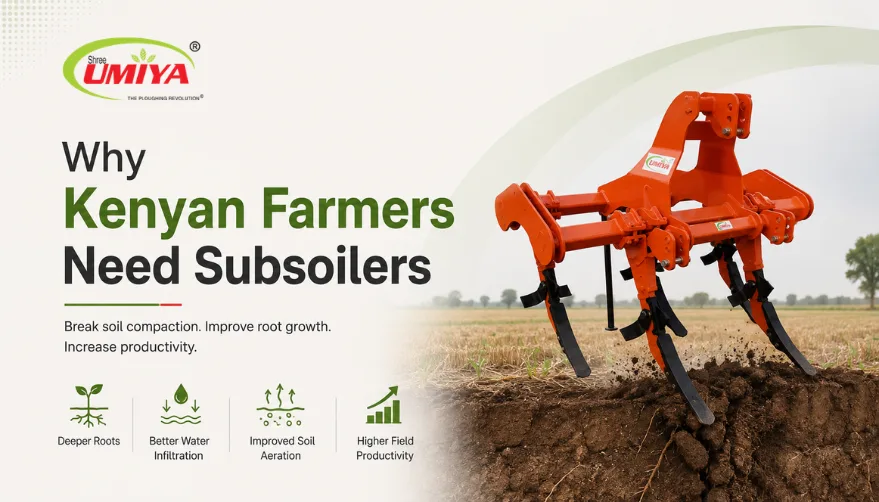
Agriculture in Kenya relies significantly on quality soils. All types of farming in Kenya rely on soil that enables good root development, proper absorption of rainfall and remains productive upon repeated cultivation. In all these, soil compaction acts silently to ruin all these. Soil at the surface might look like an ideal place to plant in but under it lies a dense layer that hinders root development, water absorption and air circulation.
A Subsoiler would be a useful piece of equipment to use in such modern day farms. Its ability to work beyond the conventional tillage depth will help create suitable conditions for root development in the soil.
The Problem Beneath the Surface
Compacted soils are not easily identifiable at first glance. Tractor traffic, use of heavy equipment, excessive cultivation, and farming on soils that have inappropriate moisture content will lead to the development of compact layers beneath the surface layer of soils.
The presence of such compact layers will inhibit root penetration and proper percolation of water within the soil profile. In the event that the necessary moisture is made available to the crops either due to sufficient irrigation or sufficient rainfall, crops may find it difficult to absorb any moisture.
This will prove significant to Kenyan farmers whose soils have different characteristics.
When Roots Hit a Wall, Crops Feel the Difference
Roots require space to develop. In the presence of a compacted layer of soil, root growth is likely to be inhibited, leading to difficulty accessing water and nutrients present in lower layers of the soil.
The problem may get worse during times of drought, since crops with root development that is hindered by compacted soil are likely to be more affected by the lack of rainfall.
By breaking the compacted layer, roots will be able to penetrate deep into the soil. Rather than developing in the upper layer of the soil profile, roots may be able to access deeper layers.
Let Rainwater Go Where Crops Need It
Kenya experiences diverse rainfall patterns, and effective water management is important for agricultural productivity. Heavy rainfall can create runoff when water cannot infiltrate the soil properly, while compacted ground may prevent moisture from reaching deeper layers.
Deep soil loosening can help create channels through compacted areas, supporting better water infiltration. This does not eliminate the effects of heavy rainfall or drought, but it can improve the soil's ability to receive and store water when field conditions are suitable.
Better infiltration can also help reduce excessive surface runoff and make more effective use of available rainfall.
Give the Soil More Room to Breathe
The soil is not just a growth medium. It consists of air, water, organic matter, microorganisms, and nutrients interacting to aid plant growth. Compacting the soil too much could result in reduced space between the soil particles, thus hindering air and water flow.
Loosening the compacted soil could help improve the physical state of the soil and provide a better habitat for the plants and the soil organisms. Nevertheless, deep tilling should only be done in case of soil compaction and not routinely on all fields.
Make Existing Farming Practices Work Better
Subsoiler should not be treated as a tool that should replace all other tillage equipment. Rather, it can serve as an additional element in the overall soil management process.
It is possible to analyze the farm land and determine locations where there is compaction preventing root growth, infiltration, or proper drainage. In such cases, deep cultivation can be performed first, followed by seedbed preparation.
This approach may enable farmers to avoid unnecessary field coverage, concentrating efforts only in those places where maximum benefit can be derived from the process.
What Kenyan Farmers Should Consider Before Using One
Choosing the right equipment requires consideration of actual field conditions. Soil type, depth of compaction, tractor capacity, field size, and moisture conditions can all influence performance.
Farmers should first determine whether a compacted layer exists and identify its approximate depth. Operating equipment when the soil is excessively wet may smear or deform the soil rather than create the desired loosening effect. Extremely dry ground can also require greater pulling power.
Matching the implement to the tractor is equally important. The equipment should have suitable working depth and configuration for the available tractor so that the operation can be completed efficiently without unnecessary strain.
Farmers working with reliable agricultural equipment from Shree Umiya Agro can consider their field conditions and machinery requirements when developing a practical soil-management approach.
Break the Barrier to Better Root Growth
However, when it comes to the farmers in Kenya, they require the ability of soil to allow the growth of the crop below the topsoil layer too. Deep compaction could result in hindrance to roots development, poor water infiltration, and reduced efficiency of other inputs used in the field. Once such an issue is discovered in the field during the assessment, the use of Subsoiler can solve the problem.
If you need high-quality agricultural implements to manage your soil and conduct effective field work, Shree Umiya Agro has the right products for your Kenyan farm.
FAQs
Ques
What does a Subsoiler do?
Ans
A Subsoiler breaks compacted soil layers below the normal ploughing depth, helping improve root penetration, water infiltration, drainage, and soil aeration.
Ques
How do I know if my field needs a Subsoiler?
Ans
Common signs include poor drainage, standing water after rain, shallow root growth, reduced crop performance, hard soil below the surface, and difficulty penetrating the soil with other tillage equipment.
Ques
Is a Subsoiler useful in Kenyan soils?
Ans
Yes. A Subsoiler can be useful in compacted clay, loamy, and other cultivated soils across Kenya, particularly where repeated tractor traffic or continuous cultivation has created dense subsurface layers.
Ques
When should a Subsoiler be used?
Ans
Subsoiling is usually most effective when the soil is neither too wet nor too dry. Excessively wet soil may smear, while very dry soil may require greater tractor power.
Ques
Does a Subsoiler replace other tillage equipment?
Ans
No. A Subsoiler is typically used to break deep compacted layers, while other implements are used later for seedbed preparation and secondary tillage.

Shree Umiya
Farm Implements Manufacturer
As a proud member of the Shree Umiya team, I'm here to share our expertise & insights of high-quality farm implements like reversible ploughs & tractor operated sprayers. Join us to explore the commitment to quality that define our brand.
Latest Posts
-
September 22, 2026
-
September 21, 2026
-
September 17, 2026
