Chat With Us
+91 98256 37969
Benefits of Mist Blowers in Fruit Orchards
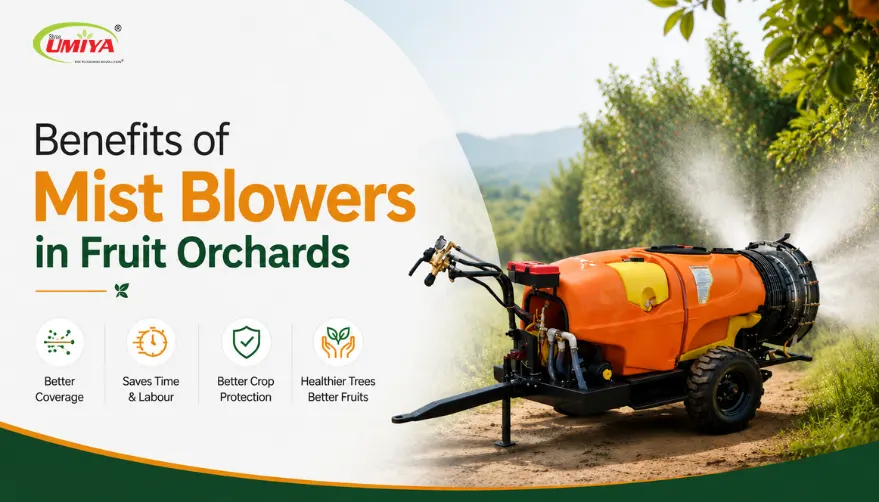
Orchards of fruits need regular care during the entire growth cycle. The fruiting process from flowering until ripening is susceptible to various problems such as pests, fungi, and other factors that can reduce productivity and fruit quality. However, it is not enough to provide plant protection with crop protection agents but to apply them properly on the right plant areas as well.
This is where a Mist Blower can make orchard management more efficient. By producing a fine spray and helping distribute it across plant canopies, the equipment supports more uniform application while reducing the effort involved in treating large numbers of trees.
What is a Mist Blower?
A mist blower is an agricultural spraying machine that uses air pressure to distribute fine droplets of pesticides, fungicides, and liquid nutrients across fruit trees and dense orchard canopies. In Indian orchards, mist blowers help farmers achieve better spray coverage, reduce manual labour, save time, and improve overall crop protection efficiency.
Benefits of using a Mist Blower in fruit orchards
- Better coverage inside dense tree canopies
- Faster spraying across large orchard areas
- More efficient use of pesticides and fungicides
- Reduced manual labour and operator fatigue
- Improved protection against pests and fungal diseases
- Support for healthier trees and better-quality fruits
- More consistent orchard management throughout the growing season
How Does Mist Blower Work in Fruit Orchards?
Trees that bear fruits can be dense in their foliage. As such, there may be spots that are hard to cover while using traditional spraying techniques. A spray that can only coat the exterior part of the canopy will not protect the inner leaves.
A Mist Blower uses high-speed airflow to carry fine spray droplets deep into dense fruit tree canopies, improving coverage of leaves, branches, and developing fruits. This can be particularly useful in orchards where plant protection requires regular and thorough application.
Better coverage does not necessarily mean applying more product. Instead, it allows farmers to focus on distributing the required solution more effectively across the crop.
Why Is Canopy Coverage Important in Fruit Orchards?
The structure of fruit trees makes spraying different from treating low-growing crops. Branches, leaves, and developing fruits can create multiple layers that need adequate coverage.
The airflow generated by a mist blower helps move the spray into areas that may otherwise be difficult to reach manually. This makes the equipment useful for orchards with dense canopies, where achieving consistent application is an important part of crop management.
Better penetration can also reduce the likelihood of untreated sections remaining within the orchard, supporting a more uniform crop protection strategy.
How Does a Mist Blower Improve Spraying Efficiency?
Treating a large orchard manually can consume considerable time, particularly when trees require repeated applications during the season. The process may involve significant walking, carrying equipment, and repositioning between rows.
Mechanized spraying can make these operations more efficient. Farmers can cover larger areas within a shorter working window, allowing them to respond more promptly when crop protection becomes necessary.
This improved speed is especially valuable during periods when weather conditions or pest pressure make timely application important.
Can a Mist Blower Reduce Chemical Waste?
It is important to note that wastage of chemicals does not necessarily ensure the cost-effectiveness of the production process, since the excessive use of chemicals will lead to the waste of additional production costs.
In this regard, the proper operation of the mist blower allows the spray to be distributed within the necessary agricultural area, which means that farmers should pay attention to the effectiveness of the application of products rather than the volume of their use.
Certainly, all other factors should still be taken into account, including the appropriate concentration, speed of spraying, settings of nozzles, and others.
Does a Mist Blower Reduce Labour in Orchard Farming?
Spraying in the orchards is physically laborious when done manually, particularly in large-scale orchards. The task becomes physically stressful for the workers and slows down the process as well due to carrying the equipment and going from one row to another.
The mechanization helps reduce some physical labor and helps the farm workers concentrate on observing the plants, controlling the machinery, and doing other important tasks in the orchard.
How Does Proper Spraying Support Better Fruit Quality?
Appropriate crop protection helps contribute to keeping plants in good condition regarding their leaves, branches, flowers, and even fruit-bearing parts. With proper protection from various pests and diseases, trees will have an opportunity to stay healthy and devote their energy to fruit production.
In terms of commercial farming, apart from the volume of the product, appearance, uniformity, and quality should also be taken into consideration.
Utilization of appropriate spraying equipment provided by Shree Umiya Agro will help orchard owners manage crop protection more easily and efficiently while keeping field work consistent.
Manual Spraying vs Mist Blower in Orchards
| Factor | Manual Spraying | Mist Blower |
| Canopy coverage | Limited | Better penetration |
| Labour requirement | High | Lower |
| Time required | More | Less |
| Suitability for large orchards | Moderate | High |
| Spray distribution | Uneven | More uniform |
| Operator fatigue | Higher | Lower |
What Should Farmers Consider Before Buying a Mist Blower?
Efficient orchard management involves various components. Some of the aspects that determine productivity include irrigation, pruning, nutrition, weed control, and pest and disease management. The spraying machine should thus be a part of the broader orchard management system and not just an individual solution.
The choice of the machine depends on several elements such as the height of the trees, density of the canopies, size of the orchard, space between the rows, terrain, and the type of power source.
Why a Mist Blower Is a Smart Investment for Fruit Orchards
Production of healthy fruits relies on the ability to protect the trees properly at the proper time and be able to get into the zones where diseases and pests could emerge. In this regard, a mist blower facilitates this process by providing canopy coverage, enabling easy spraying, requiring low labor, and assisting in effective farm management.
For farmers who are in need of a reliable system for spraying their orchards, Shree Umiya Agro provides equipment that will ensure efficient farming operations.
FAQs
Ques
What is a mist blower used for in fruit orchards?
Ans
A mist blower is used to spray pesticides, fungicides, and liquid nutrients on fruit trees by using air pressure to distribute fine droplets across the canopy.
Ques
Which fruit crops commonly use mist blowers in India?
Ans
Mist blowers are commonly used in mango, citrus, guava, pomegranate, apple, and other commercial fruit orchards.
Ques
Does a mist blower save labour?
Ans
Yes. Compared with manual spraying methods, a mist blower can reduce physical effort and help cover larger orchard areas more efficiently.
Ques
Can a mist blower improve spray coverage?
Ans
Yes. The air-assisted spray helps the droplets reach inner leaves, branches, and fruit-bearing areas that may be difficult to cover with conventional spraying methods.
Ques
What should farmers check before buying a mist blower?
Ans
Farmers should consider orchard size, tree height, canopy density, row spacing, terrain conditions, power source, and availability of service and spare parts.

Shree Umiya
Farm Implements Manufacturer
As a proud member of the Shree Umiya team, I'm here to share our expertise & insights of high-quality farm implements like reversible ploughs & tractor operated sprayers. Join us to explore the commitment to quality that define our brand.
Latest Posts
-
September 22, 2026
-

September 21, 2026
-

September 17, 2026
