Chat With Us
+91 98256 37969
Rotavator Buying Guide for Ghana: How to Choose the Right Rotavator
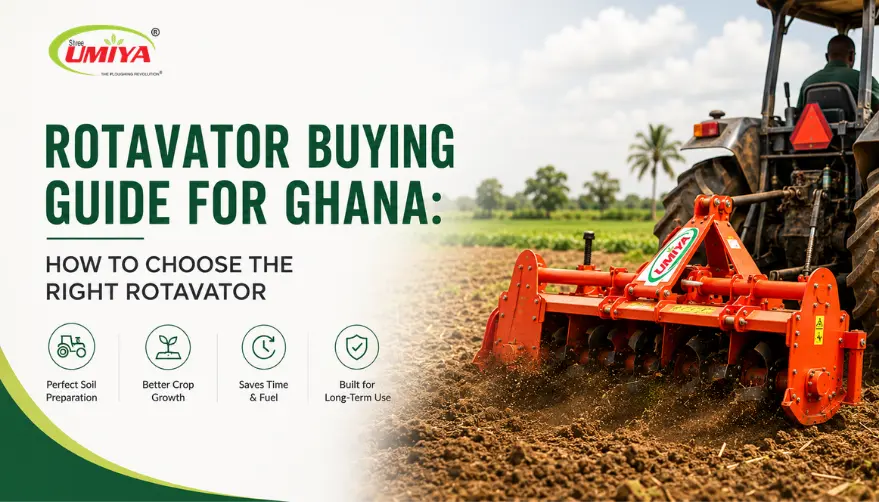
Buying a Rotavator for a farm in Ghana requires more than comparing prices. Ghanaian farmers work with different soil types, varying rainfall patterns, diverse crop residues, and tractors of different power capacities. Choosing the right Rotavator can improve soil preparation, reduce fuel and labour costs, create a better seedbed, and support more efficient farming operations across multiple agricultural seasons.
This Rotavator buying guide for Ghana explains the key factors farmers should evaluate before purchasing a machine, including soil condition, tractor compatibility, working width, blade quality, residue management, maintenance requirements, and long-term farm planning.
What Should Ghanaian Farmers Check Before Buying a Rotavator?
Before purchasing a Rotavator, Ghanaian farmers should evaluate:
- Soil type (sandy, clay, loamy, or hard soil)
- Tractor horsepower and hydraulic compatibility
- Working width suitable for farm size
- Blade quality and frame durability
- Crop residue levels in the field
- Maintenance and spare-parts availability
- Fuel efficiency and long-term operating cost
Considering these factors helps farmers choose a machine that matches their field conditions and reduces unnecessary repair and fuel expenses.
Why Rotavator Selection Matters in Ghana
Ghanaian agriculture includes maize, rice, cassava, vegetables, and other crops grown under different rainfall and soil conditions across the country. Farmers often need to prepare land quickly during limited planting windows while managing crop residues and conserving soil moisture. A properly selected Rotavator can help improve field preparation efficiency, support more uniform seed placement, and reduce the number of tillage operations required before planting.
Start with the Soil, Not the Price Tag
Soil conditions should be among the key factors to consider before selecting tillage implements. Ghanaian farmlands have varying soil textures and field conditions; hence, an implement that works perfectly well on one farm does not necessarily mean it will do the same job effectively on other farms.
Farmers need to check whether their farmland is loose, cloddy, hard, has lots of residues or retains water easily. Soil conditions can affect the depth of operation, blade arrangement, tractor power, among others.
Using soil conditions as a basis for selecting tillage implements helps farmers avoid using machinery that cannot serve their purpose effectively or one that poses unnecessary challenges to them.
Choose a Rotavator That Matches Your Tractor
The tractor and the implement should complement each other. Prior to purchase, the farmer needs to evaluate whether the horsepower and hydraulics of the tractor match those of the implement.
Too large a machine might impose a burden on a small tractor, and an implement which is too small might lack the working width necessary to a bigger farming operation.
It is hence important for the farmer to match the equipment based on the recommendations provided by the manufacturer and based on the tractor available on the farm.
Select the Right Rotavator Working Width
The width of work influences the amount of area that can be covered by one pass of the implement. The greater width is useful for bigger farms since it helps to decrease the number of passes made while preparing the field.
Nevertheless, the bigger size of the implement does not necessarily mean higher productivity. The size should suit both the capabilities of the tractor and the field size. The smaller farm or the narrower field can be prepared using the more compact combination.
The best solution is the balance of all factors mentioned above.
Check Rotavator Blade Quality and Construction
The blades are among the most important working components of a tillage implement because they are directly exposed to soil, crop residue, and field debris.
Farmers should look for strong construction and durable components that can withstand regular field use. The frame should also be robust enough to handle the operating conditions without compromising stability.
A well-built machine may provide more consistent performance over time and reduce the frequency of repairs or component replacement. Farmers should also consider how easily wear parts can be inspected, maintained, and replaced.
Think About What Happens to Crop Residue
Crop residue can influence how an implement performs. Fields containing stalks, leaves, and other plant remains may require equipment capable of cutting and mixing the material effectively.
A Rotavator can help incorporate manageable crop residues into the soil while simultaneously working the upper soil layer. This can make it useful for farmers who want to combine residue management with seedbed preparation.
However, residue quantity should be considered before purchasing. Extremely heavy residue loads may require a different sequence of field operations or additional residue-management equipment.
Make Your Buying Decision with the Whole Farm in Mind
The tillage implement must blend well within the agricultural system as opposed to being chosen in isolation. Farmers need to think about the number of times it will be used, the type of crop it will cultivate, the size and quality of their farms, and the implements they have.
There should be consideration for future expansion too. The tillage implement that fits current needs but lacks capacity for growth will require replacement at an earlier time than was envisaged.
By taking the whole agricultural enterprise into consideration, buyers will choose equipment that offers functional value as opposed to buying the most powerful one.
Buy for Your Fields, Not Just for the Machine
Choosing the appropriate tillage equipment to use in a Ghanaian farm depends on factors such as the state of the soils, compatibility of the equipment with the tractor, working width, blades, residue, working depth, maintenance, and economic viability of the chosen machine. Making the appropriate choice will help in soil preparation as well as effective utilization of time, fuel, and machines by farmers.
If you are in need of reliable farm equipment, Shree Umiya Agro provides agricultural tools that will help farmers make soil preparation easier.
FAQs
Ques
What is a Rotavator used for?
Ans
A Rotavator is used for breaking soil clods, mixing crop residues, preparing seedbeds, and creating a more workable soil surface before planting.
Ques
Which Rotavator is best for Ghanaian farms?
Ans
The best Rotavator depends on the farm’s soil type, tractor horsepower, field size, and crop residue conditions. There is no single model that suits all farms.
Ques
How do I know if my tractor can operate a Rotavator?
Ans
Check the tractor’s horsepower, PTO compatibility, hydraulic lifting capacity, and recommended implement width provided by the manufacturer.
Ques
Can a Rotavator handle crop residues?
Ans
Yes. A Rotavator can help incorporate moderate crop residues such as stalks and leaves into the soil while preparing the seedbed.
Ques
Does a wider Rotavator always improve productivity?
Ans
No. A wider Rotavator should match both the tractor’s power capacity and the field dimensions. Oversized equipment can reduce efficiency and increase fuel consumption.

Patel Agro
Farm Implements Manufacturer
As a proud member of the Shree Umiya By Patel Agro Industries team, I'm here to share our expertise & insights of high-quality farm implements like reversible ploughs & tractor operated sprayers. Join us to explore the commitment to quality that define our brand.
Latest Posts
-
August 24, 2026
-
August 19, 2026
-
August 17, 2026
