Chat With Us
+91 98256 37969
Rotavator Benefits for Soil Preparation in Zimbabwe
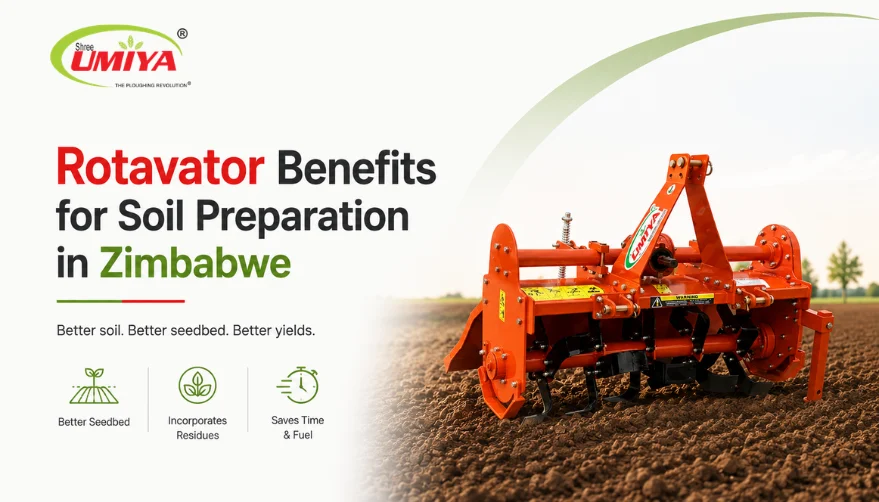
How can Zimbabwean farmers prepare a better seedbed while reducing time, fuel, and labour costs?
One of the most effective solutions is a Rotavator, which cuts, breaks, and mixes the soil in a single operation. In Zimbabwe, where soil conditions vary across regions and efficient use of water and machinery is increasingly important, proper soil preparation can significantly improve germination, root development, and overall crop establishment.
A Rotavator combines soil cutting, breaking, mixing, and leveling operations in a single pass, helping farmers prepare a more uniform seedbed with fewer field operations.
What is a Rotavator and why is it useful for soil preparation?
A Rotavator is also know as rotary tiller. A tractor-mounted tillage implement that uses rotating blades to cut, break, mix, and level soil during land preparation. It is useful because it can create a finer seedbed, incorporate crop residues, reduce the number of tillage passes, improve seed-to-soil contact, and help farmers prepare fields more efficiently before planting.
Benefits of using a Rotavator in Zimbabwe
- Breaks large soil clods into finer particles
- Mixes crop residues into the soil
- Creates a more uniform seedbed
- Reduces repeated tillage passes
- Saves time and fuel during land preparation
- Supports better seed germination and root establishment
A Better Seedbed Starts Before the Seeds Go In
The placement of the seed itself is only one step to ensuring that the crops grown are healthy. The area around the seed should offer the proper environment for seed germination and root establishment. Large clods can cause variations in seeding, while excess plant residue or an uneven surface can pose problems during field work.
A properly prepared seedbed will allow for the creation of a more uniform environment throughout the field. Through the use of mechanized tillage equipment, clods are broken and the soil surface is mixed.
The idea is not to disturb the soil needlessly but rather to create the proper physical environment for further growth.
For Zimbabwean farmers growing maize, tobacco, soybeans, or other seasonal crops, timely land preparation is especially important because planting windows are often closely linked to rainfall patterns.
Turn Rough Ground into a More Workable Seedbed
The land may become tough to work on as a result of its repeated use, its prior harvesting, or exposure to different climatic conditions. In relation to the type of soil in question, the farmer may have to deal with hard spots, unevenness, and clods which require breaking before planting.
The rotavator cuts into the soil with the help of rotating blades; thus, it breaks down the larger clods while working the soil. It produces an even and finer surface for planting.
A more uniform field surface can make planting, irrigation management, and subsequent field operations easier and more consistent across the entire cultivated area.
Make Every Pass Across the Field Count
Repeated tillage passes consume fuel, time, and machinery hours. For farmers managing larger areas, unnecessary passes can make land preparation more expensive and delay planting.
Using an implement capable of carrying out several soil-preparation functions in one operation can improve field efficiency. By cutting and mixing the soil while preparing the surface, a rotavator may reduce the number of separate operations required, depending on the field condition and tillage plan.
Fewer passes can also reduce the time that machinery spends travelling over the same land, allowing farmers to move on to planting and other seasonal activities sooner.
Put Crop Residues Back to Work
Post-harvest, there is likely to be stalks, leaves, stems, and other plant residues in the fields. The buildup of too much residues on the surface could make future work in the farm difficult, while the removal and burning of the residues will mean the loss of an opportunity to add organic material to the soil.
If conditions and agricultural practices permit, soil cultivating machinery can help incorporate reasonable amounts of crop residues into the top soil layers. As they decompose, they become organic material in the soil.
This method transforms the waste products into useful materials for cultivation in the next farming cycle.
Give Roots a Better Place to Establish
Good soil preparation should support more than the appearance of the field. It should create conditions that allow roots to establish and access essential water and nutrients.
A suitably prepared seedbed can provide better contact between seeds and surrounding soil, supporting more uniform germination. A balanced soil structure also allows roots to develop through the prepared layer without encountering excessive clods.
However, farmers should avoid assuming that deeper or more aggressive tillage is always better. Soil type, moisture, existing compaction, and crop requirements should determine the appropriate tillage approach.
Use Moisture Wisely During Land Preparation
Water management is especially important when preparing agricultural land. Soil that is excessively wet can stick to equipment and become smeared, while very dry and hard soil may require considerably more power to work effectively.
Farmers should therefore consider field moisture before operating tillage machinery. Working within suitable conditions can help achieve better soil preparation while reducing unnecessary fuel consumption and wear on the equipment.
The correct timing can be just as important as the implement itself.
Prepare the Soil Today for a Better Crop Tomorrow
Effective agricultural practices begin with providing plants with the appropriate environment from the start. The efficient preparation of the soil will assist Zimbabwean farmers with their challenge of dealing with uneven seed beds, soil clumps, reasonable crop residues, and the need to finish field preparations within their available seasons. The Rotavator assists with such tasks by mixing the soil as well as preparing the surface for cultivation.
Should you seek reliable machines for improving soil preparation, Shree Umiya Agro provides implements that will enable efficient field operations and assist Zimbabwean farmers with practical land preparation.
FAQs
Ques
What is a Rotavator used for?
Ans
A Rotavator is used for soil preparation before planting. It breaks clods, mixes soil, incorporates crop residues, and creates a finer seedbed for better crop establishment.
Ques
Is a Rotavator suitable for Zimbabwean farms?
Ans
Yes. Rotavators can be used on many Zimbabwean farms for preparing land for crops such as maize, tobacco, soybeans, and vegetables, depending on soil conditions and tractor compatibility.
Ques
Can a Rotavator reduce fuel and labour costs?
Ans
It can help reduce repeated tillage operations by performing several soil-preparation functions in a single pass, which may improve field efficiency and reduce operating time.
Ques
Should a Rotavator be used in very wet soil?
Ans
No. Excessively wet soil can stick to the blades and create poor soil structure. Farmers should operate a Rotavator when soil moisture conditions are suitable for effective tillage.

Patel Agro
Farm Implements Manufacturer
As a proud member of the Shree Umiya By Patel Agro Industries team, I'm here to share our expertise & insights of high-quality farm implements like reversible ploughs & tractor operated sprayers. Join us to explore the commitment to quality that define our brand.
Latest Posts
-
August 24, 2026
-
August 19, 2026
-
August 17, 2026
